
Slide toggle

İletişim Adreslerimiz

Monday - Friday: 09:00 - 18:00 Camikebir Mah. Atatürk Cad.No:7 Kat:2 Daire:211 Seferihisar / İzmir - Turkey +90 850 304 40 42 +90 540 313 03 03 ( Whatsapp ) info@tajamarble.com
Black and White Modern Travel Magazine

Turkish Marble in Hagia Sophia’s Foundations

The story of Hagia Sophia is not just written in history books—it is etched into stone. From the rolling mountains of Marmara Island to the sacred floor of one of the world’s most iconic buildings, Turkish marble has played a central role in shaping architectural history. This is a journey not only of empires, but of the timeless materials that held them together.

A Vision in Stone: The Birth of Hagia Sophia

Commissioned in 537 AD by Emperor Justinian I, Hagia Sophia was meant to stand as the spiritual and architectural pinnacle of the Byzantine Empire. But building something that would last centuries required more than vision—it required material strength and unmatched beauty.
That’s where Turkish marble came in.

From the very foundations to the most elaborate decorative columns, natural stones from across Anatolia were brought together to give the structure not only strength but presence. Among these, one marble stood out: Marmara Marble.
Marmara Marble: The Spine of Sacred Architecture

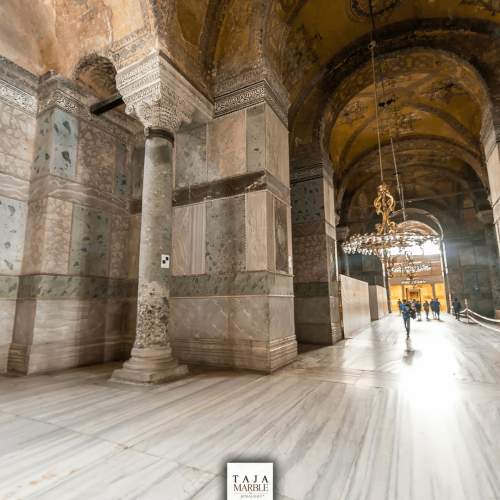
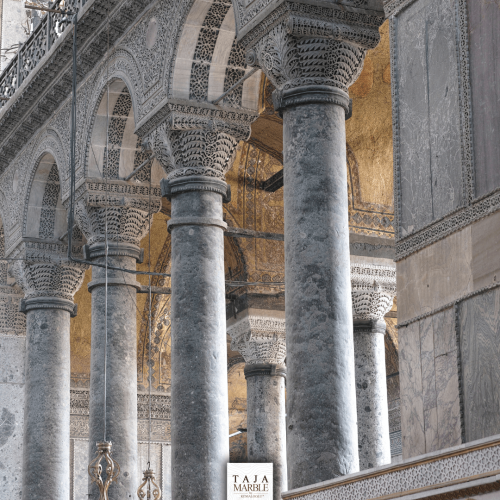
Quarried from the island of Marmara in the Sea of Marmara—known in ancient times as Proconnesus—Marmara Marble has a distinctive linear veining and a luminous white background. Its durability and easy polishability made it the perfect choice for large architectural components such as columns, revetments, and floors.

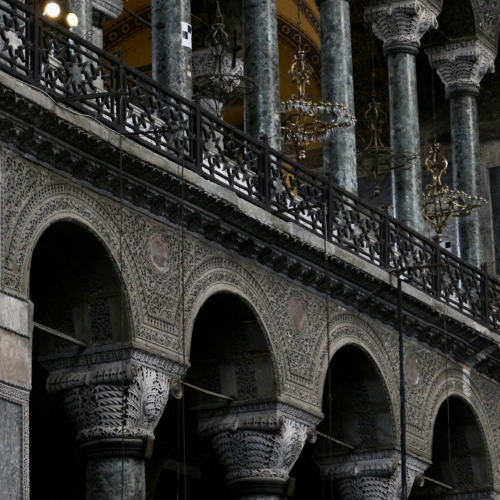
In Hagia Sophia, massive Marmara columns rise into the vaulted domes, uniting earth and heaven in sacred geometry. The veining in these marbles catches light from chandeliers and windows, shifting the mood of the interior through the day.

Beyond Marmara: The Diversity of Turkish Stones in Hagia Sophia

Marmara was not alone in its journey to Constantinople. The Byzantine architects selected stones from all over Anatolia, each chosen for its visual character and symbolic power:

Afyon White Marble: Used in decorative panels and altar bases for its pristine clarity.
Milas Lilac Marble: Its purple veining symbolized imperial power and spiritual ascension.
Afyon Violet Marble: With its rich violet and smoky undertones, it added both mystique and depth to the architectural palette, especially in niche detailing and ornamental wall sections.

These stones were more than materials—they were narratives in color and pattern, representing a union of nature and empire.

3

Turkish Marble in Contemporary Design

Today, these same marble types continue to live on—not just in mosques and churches, but in hotels, villas, spas, and commercial buildings around the world.
With modern finishes like honed, brushed, and polished surfaces, Turkish marbles are being reintroduced into modern interiors—maintaining their ancient soul while embracing new aesthetics.

Designers are particularly drawn to the Marmara White, which now finds use in minimalist kitchens and boutique bathrooms. Similarly, Afyon White and Milas Lilac are becoming favorite choices for bookmatched walls and statement floors.

15

In the heart of Hagia Sophia, we are reminded that architecture is more than structure—it is a story carved in stone.

The marbles that rise within its sacred halls are not only materials of strength, but symbols of devotion, power, and timeless beauty.

From the cool precision of Marmara Marble to the mysterious depth of Afyon Violet, each stone tells a tale—of empires, artisans, and a nation rich in legacy.

These materials were chosen not merely for their elegance, but for what they represent: permanence, culture, and spiritual resonance.

Today, as designers, architects, and visionaries continue to shape the future of space, these same stones carry forward their ancient voice. Through modern design, they remind us that beauty is most powerful when it is honest, rooted, and enduring.

At Taja Marble, we are proud to bring this legacy into contemporary life—refining Turkish stone not only for its form, but for the stories it carries.

Materials Matter. Legacy Lives.

Every architectural masterpiece begins with a material—and every lasting legacy is shaped by what we choose to build with. From ancient empires to modern-day marvels, stone has always been more than a structure; it has been a statement.

At Taja Marble, we believe that the integrity of a space lies not only in design but in the substance that carries it. That’s why we work with timeless Turkish marble—used in icons like Hagia Sophia—to preserve history and inspire the future.

Because when materials are chosen with care, they don’t just endure—they echo across generations.